Prices as listed by En Route.
The retailer’s price may differ.
Buying outside the United States
- Buy, AustraliaAmazon
Bookstores, parishes, and schools:
Order direct at a discount.
- Subject
- Faith and Science
- Formats
- Paperback, Kindle, Audible
- Publisher
- En Route Books and Media
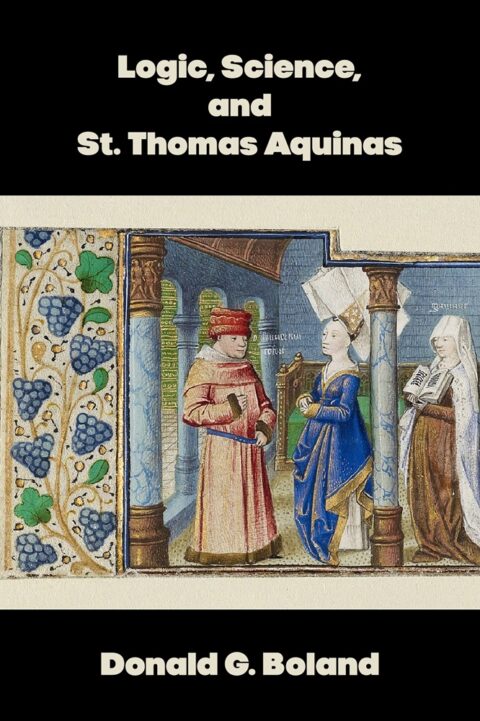
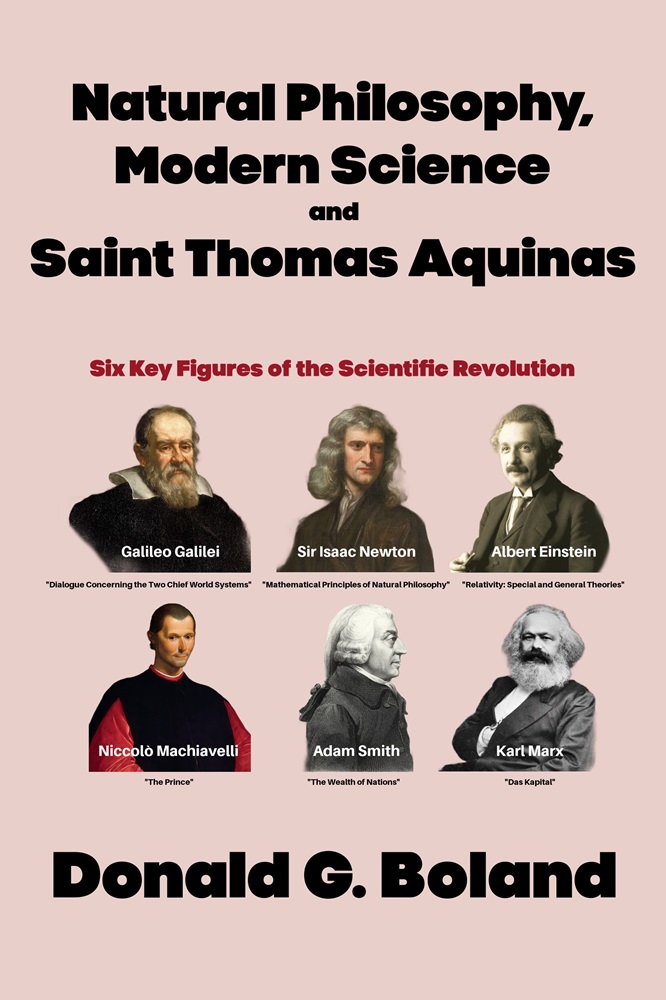
Natural Philosophy, Modern Science and Saint Thomas Aquinas
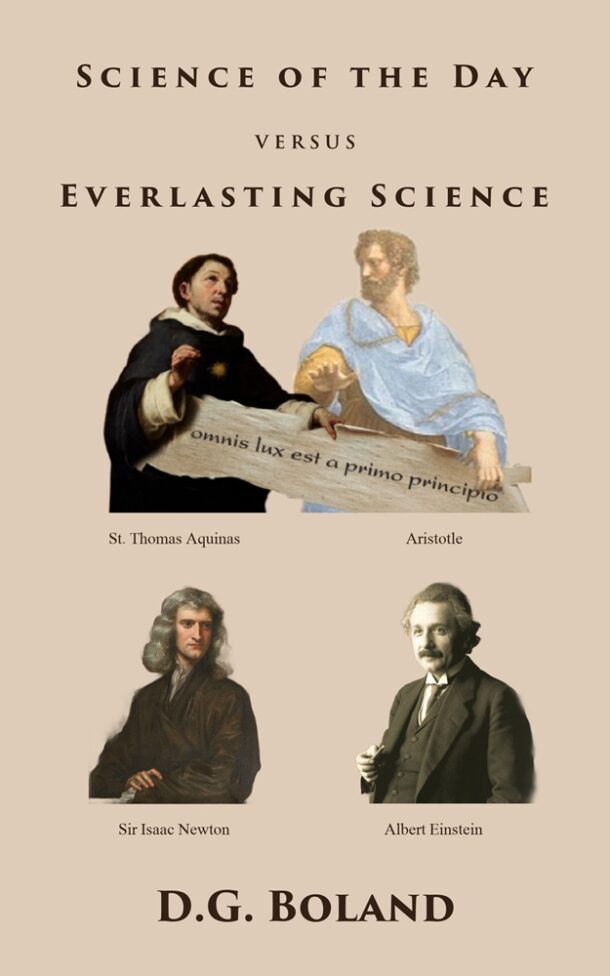
This book is an attempt to rescue the reputations of Aristotle and Aquinas in the area of science and philosophy where they are subject to most criticism and even ridicule in modern times following the scientific revolution, namely, in Physics specially and Science generally.
It is necessary to note that objection to, and rejection of, their thought in this regard is not confined to scientists and philosophers of a non-religious or anti-religious cast of mind, but is also shared, if reluctantly, by those who would regard themselves as generally admirers of Aristotle as a theist philosopher, and even those who would declare themselves disciples of Aquinas in all other respects, going by the name of Thomists.
Most, including Thomists, would see the ancient and medieval notions of science, ascribed to Aristotle and Aquinas in this precise regard, as not able to be reconciled at all with modern thought, so that we might as well get used to the idea that the pre-modern notions of physics and science were seriously mistaken.
However, there are some Thomists, such as Maritain, who have endeavoured to argue for a solution to the apparent contradiction. The author, whilst prepared to defend the truth of Aristotle’s and Aquinas’ fundamental position and indeed to criticise the modern disdain for it, nonetheless disagrees also with the efforts of the Thomists to date to do the same.
Readers on both sides of the debate will be surprised to discover compatibility with the author’s arguments.
Praise
“The first part of this book is devoted to the corpus of works of Aristotle on natural science (natural philosophy) and the extensive commentaries of St. Thomas Aquinas. It exposes and discusses the right ordering and principles or causes of the natural sciences in their completeness as handed down by these two great masters of natural philosophy. From that perspective alone Dr. Boland’s book is a much needed contribution to philosophical and scientific discourse in both secular and Catholic academic circles of our age. However, the book does not end in the mists of time with a medieval friar better known for sacred theology. The abundant light shining from the Common Doctor and The Philosopher in the first part of the book serves, in the capable hands of Dr. Boland, to illuminate with clarity and precision the true nature of modern science from its inception in the seventeenth century until the present time. Despite the material benefits this limited and mathematically formal science has accrued to mankind, the philosophical errors therein are serious and extensive. These errors, especially the fundamental scepticism of modern philosophers of science such as Sir Karl Popper, are exposed and roundly refuted in the second part of the book. There is however, another bonus in store, which for modern day Thomists will be something of a shock. I speak here of the serious attempts well known and greatly admired Thomists such as Maritain, Charles De Koninck MSRC and William Wallace OP have made to engage with modern scientific theories from a Thomistic perspective, but in doing so, as Dr. Boland so astutely points up by applying the principles exposed in the first part of the book, they have departed from St. Thomas in a fundamental way. Overall, this book is an excellent foundation for the right understanding of the philosophy of nature in its entirety and for the identification of the errors of modern theories of science. Not only does it deserve a wide readership amongst teachers and students of philosophy, science and technology, but also amongst teachers and students of ethics, politics and theology. I give it my unreserved recommendation.”
About the Author
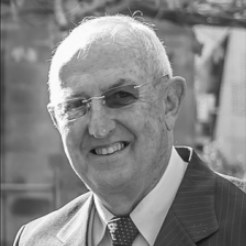
Donald G Boland Ll. B. (Sydney), Ph. D. (Angelicum) is a founding member of the Centre for Catholic Studies Inc. in Sydney Australia and is one of its former Presidents. He practiced for a number of years as a lawyer having a degree in law from the University of Sydney. Over much the same time, having obtained a doctorate in philosophy from the University of St. Thomas in Rome, he has taught philosophy and law in both Catholic and secular educational institutions, such as the University of Technology, Sydney, the University of Newcastle, the Aquinas Academy, the Centre for Thomistic Studies Inc., now operating under the name of the Centre for Catholic Studies Inc., and various Catholic seminaries, such as those of the Marists and the Vincentians. His doctoral thesis was on the concepts of utility and value in economics as found in the works of Aristotle and St. Thomas Aquinas.