Prices as listed by En Route.
The retailer’s price may differ.
Bookstores, parishes, and schools:
Order direct at a discount.
- Subject
- Practical Theology
- Formats
- Paperback, Kindle
- ISBN
- 9781952464089
- Publisher
- En Route Books and Media
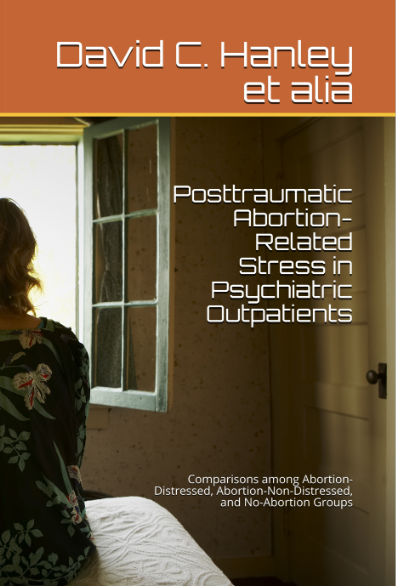
Posttraumatic Abortion-Related Stress in Psychiatric Outpatients
Comparisons among Abortion-Distressed, Abortion-Non-Distressed, and No-Abortion Groups
Third Place, Life and Dignity, Catholic Media Book Awards 2021
Objective: This study examines potential risk factors for long-term abortion-related distress in women.
Method: One hundred and two women receiving outpatient psychiatric services were assigned to one of three groups on the basis of their reported abortion history. Women with a positive history of abortion were assigned to a distressed or non-distressed group depending on whether abortion-related distress was a primary presenting problem. Women with no history of abortion who sought outpatient services served as controls.
Results: Comparisons across groups revealed that the abortion-distressed group had symptoms consistent with Posttraumatic Stress Disorder, including intrusive thoughts of the abortion experience and active avoidance of events associated with their abortions. Two women who underwent an abortion following rape were both in the abortion-distressed group.
Conclusions: Implications for identifying women at risk for long-term distress are discussed and suggestions for clinical interventions are made.
Figure 1 in support of the Appendix entitled “Methodological Considerations in Empirical Research on Abortion.” (Anderson, Hanley, Larson, Sider) in Post-Abortion Syndrome: Its Wider Ramifications ed. by Peter Doherty (Four Courts Press, 1995). Included with permission.
Praise
“In today’s world where abortion rights advocates advance their services as health care, this 25-year-old study by David C. Hanley and others prophetically exposes abortion as the exact opposite.”
“I almost dropped to the floor when I opened the package you sent me a few days ago! What a pleasant surprise! Let me start by thanking you from the bottom of my heart for thinking of me and sending David’s research book. I will treasure it as long as I live because it reminds me so much of the clinical work that David, Steve King, and I did together on the Pine Rest Adult Services team. What a gift you and others have given! You have greatly honored the work that David did to research the literature and administer the protocols on what really happens with women who have undergone elective abortions! I wish we could still sit down together as we did in our team meetings and discuss what our clients were teaching us (!) as we tried to listen and serve them with the compassion of our Savior. We as students of the mind and emotions are also learning so much in the years since we worked at Pine Rest. The issues of attachment and bonding are so much more prominent now, not only between mother and child but also between husband and wife, friend and friend, teacher and student, and, of course, therapist and client. We are also learning so much more about how the brain reacts to traumatic experiences. We are learning that trauma is just as strong when a relationship is broken or threatened as when physical pain is administered. Advances in brain scanning (fMRI) procedures have documented and confirmed this. I hope there will be more research done, perhaps spurred by David’s work on the attachment of wounds created in pregnant mothers when they are even contemplating an abortion. Well done! —To all who participated in getting this research published!”
About the Authors
At the time of the writing in 1995:
David C. Hanley, MSW, was a Senior Clinical Social Worker at Pine Rest Christian Hospital in Grand Rapids, Michigan. Trained at the University of Michigan School of Social Work, he has specialized in treatment of women stressed by their abortions and has served as principal investigator of a clinical research study of post-abortion stress conducted at Pine Rest Christian Hospital.
Rachel L. Anderson was a doctoral student in the Human Development and Social Policy Program at Northwestern University, Evanston, Illinois. Her research focus was on women’s health, including completion of a systematic review of the medical, psychological and social effects of induced abortion on women, funded by the U.S. Department of Health and Human Services.
David B. Larson, MD, MSPH, was Adjunct Professor of Psychiatry at Duke University Medical Center, Northwestern University Medical School and the United States Uniformed Health Services. A former research psychiatrist at the National Institute of Mental Health and the U.S. Department of Health and Human Services, he then became President of the National Institute of Healthcare Research. Dr. Larson helped to develop the systematic review methodology and specialized in the public policy implication of religious commitment. He had over 160 professional publications in such policy areas as mental health diagnoses and services, the use of nursing homes, and AIDS/HIV infection.
Harry L. Piersma worked most of his career at Pine Rest Christian Hospital in Grand Rapids, Michigan, and later retired from the W.G. Hefner VA Medical Center in Salisbury, North Carolina.
D. Stephen King, MD, was a Staff Psychiatrist Pine Rest Christian Hospital in Grand Rapids, Michigan.
Roger C. Sider, MD, was a Medical Director of the Pine Rest Christian Hospital in Grand Rapids, Michigan, and professor of Human Medicine at Michigan State University. Trained at the University of Toronto and Johns Hopkins Hospital, he has published numerous articles and book chapters on psychiatric ethics and had a life-long interest in clinical care, clinical administration, and the interface of psychiatry and religion.
Photos

A Note from the Author’s Wife, Mary Hanley
Posttraumatic Abortion-Related Stress in Psychiatric Outpatients, †Hanley, Anderson, †Larson, †Piersma, †King, and Sider is also known as the Pine Rest Study.
The late David C. Hanley, MSW, BCD, noticed that women he was treating for trauma after an abortion had the same symptoms as a Vietnam veteran whom he was treating for PTSD on an inpatient ward at Pine Rest Christian Hospital, Grand Rapids, Michigan. Mr. Hanley treated the women for PTSD. They all got better. He initiated the clinical research which used standardized tests considered to be state of the art at the time. The study was conducted by clinicians and researchers on both sides of the abortion issue.
The first article was presented to the American Psychological Association, New York, 1995. The article in the appendix, “Methodological Considerations of Empirical Research on Abortion,” Anderson, †Hanley, †Larson, and Sider was published as a book chapter in Post-Abortion Syndrome: Its Wide Ramifications ed. by Peter Doherty, Four Courts Press, Dublin, Ireland, 1995.
I published the Pine Rest Study and related article because Pine Rest colleagues and women helped by this study came to Mr. Hanley’s wake in 2018. He had not seen most of them in over twenty years. The women said they continue to help other women deal with their abortion. I obtained permission to publish from all authors or their living spouses and Four Courts Press.
The book took third place honors in the “Life and Dignity of a Human Person” in the 2021 Catholic Media Book Awards.
Sincerely,
Mrs. David C. Hanley